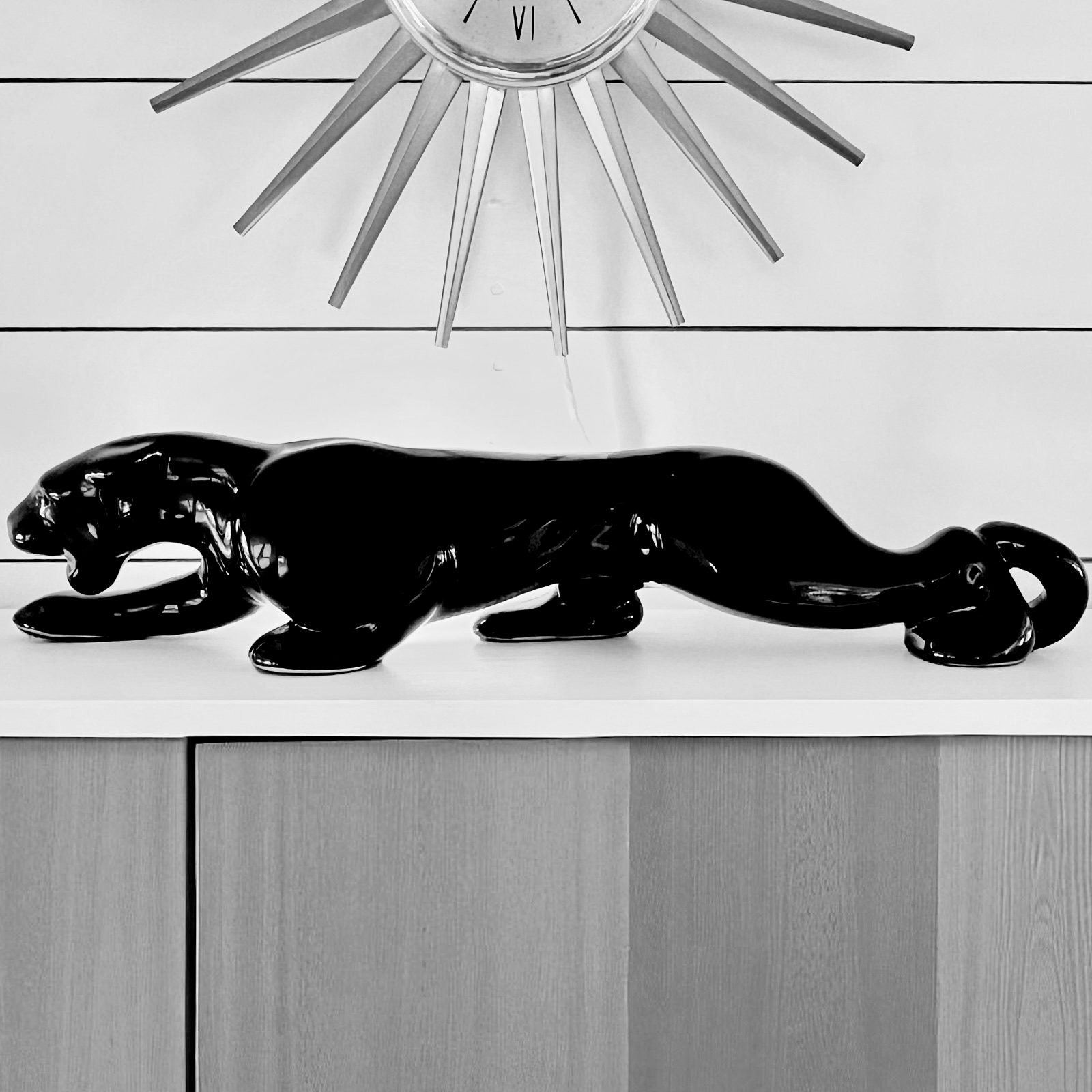
My mother’s parents, the Johnny Rielys, were a farm family until my grandfather retired and they “moved to town”—Council Grove, Kansas—in the late 1930s. In her new home, my grandmother Freda quickly became a midcentury modernist. She didn’t just adopt the style; she sought it out.
Her aluminum Christmas tree with a color wheel, pole lamps, low-back sectional sofas, and Jetson-esque Fiberglas® drapes made that clear. A suite of super-modern, light-gray Formica-clad bedroom furniture sealed the deal. She also bought one of the first large format, black-and-white console televisions in that part of Kansas.

Perched atop the big wooden TV box, above the screen, was a trophy: a sleek, crouched, hunting black panther. The ceramic cat had faceted amber eyes that glowed when the light bulb inside the shiny beast was switched on. She loved that piece.

Design
TV lamps served both a design purpose and, supposedly, a preventative one. From a design standpoint, they were expressive, often charmingly so, sometimes less so. Ceramic figures—colonial couples frozen mid-curtsy, serene Madonnas, wild animals, exotic seashells, sailing ships forever at sea—sat proudly atop TV consoles, illuminated from within or behind. Pastel glazes and glossy finishes reflected the optimism of the postwar years, when homes were filled with color, comfort, and confidence in the future. More abstract designs—geometric forms and atomic-age silhouettes—spoke to a culture eager to look modern and cutting-edge.

In magazine ads, televisions were presented as the new hearths of the midcentury home, with the TV lamp as their mantel centerpiece. Families were illustrated smiling in its glow. The lamp cast a warm light, signaling togetherness and the promise of shared time at day’s end.
Preventative
Great-Grandma Lowe had a TV lamp on her Sylvania set: a large conch shell with a bulb tucked inside. In the early ’50s, television picture tubes were fairly dim, and to see shows clearly, people often watched in the dark. Some believed that watching TV in a dark room could make you go blind. Newspaper and magazine ads articles reinforced that thought, most of them were selling … tv lamps.
In 1953, when my Mom was pregnant with my sister, Dad bought a super-deluxe Admiral television console with a radio and a turntable built in so mom would, as he said, “have something to do” while she was “waiting for the baby.”
One evening, Grandma Freda came by and said, “Oh, Patty. You don’t have a TV light? You’re going to ruin your eyes!”
Mom replied, “Dr. Essington and I talked about that, mother. He said TV lights are just a fad.”
“Oh honey,” Grandma said. “Dr. Essington is a dentist.”
I believe I grew up in a sitcom.